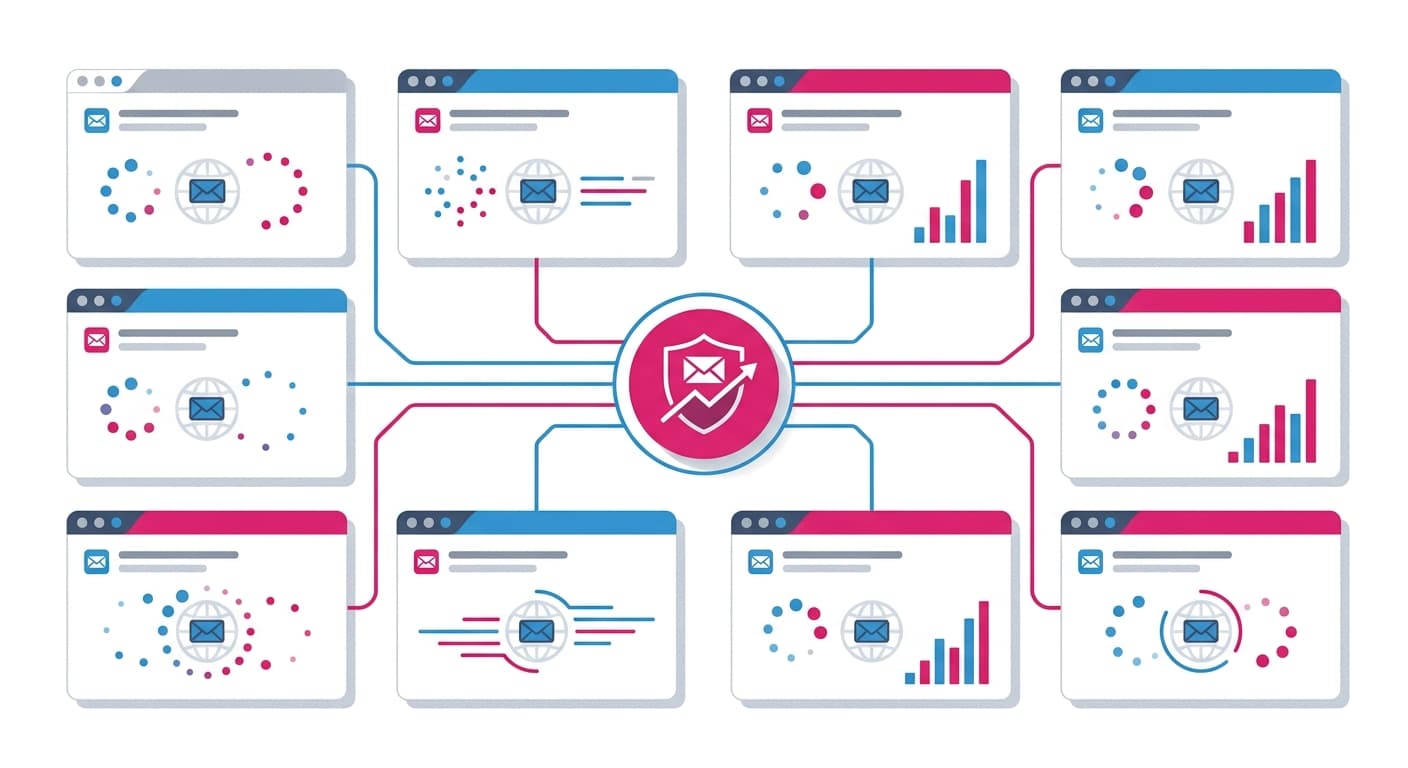
Email Warm-Up for Agencies: Managing Multiple Client Domains
How agencies manage email warm-up across dozens of client domains. Strategies for scaling deliverability as a service.
Stekpad Team
Email Deliverability Experts
The Agency Deliverability Challenge
"Managing email deliverability for a single domain is a discipline. Managing it for twenty client domains simultaneously is an operational program." Agencies that offer email marketing, outbound sales, or lead generation services as part of their product suite face a deliverability challenge fundamentally different from the one their clients face individually. When you manage a portfolio of client domains, a mistake on one domain does not stay contained — it creates operational overhead, client trust damage, and potential legal exposure that ripples across your entire book of business.
The scale of the problem becomes clear quickly. A boutique agency managing 15 active clients, each with two sending mailboxes, is responsible for the warm-up, monitoring, and ongoing health of 30 separate mailboxes. Each mailbox needs its own ramp-up schedule, its own authentication verification, its own daily health monitoring, and its own response plan when something goes wrong. If one client launches a campaign before their domain is ready, if another client's list has high bounce rates, or if a third client ends up on a blacklist — all of these events land on the agency's plate simultaneously, often with the client unaware that anything is wrong until deliverability has already collapsed.
The 2024 Google and Yahoo authentication mandates made this challenge dramatically more acute. Before the mandates, agencies could largely get away with informal deliverability management — checking on domains occasionally and addressing problems reactively. After the mandates, a client domain missing DMARC, SPF with a hard-fail qualifier pointed at the wrong servers, or a DKIM selector that was never properly configured can now cause complete email rejection rather than spam filtering. "Post-2024, an agency that does not have systematic authentication verification across its entire client portfolio is one DNS misconfiguration away from a client's email program going dark entirely." The stakes have risen to a level that demands systematic, automated management — not manual checking.
There is also a commercial dimension. Agencies that consistently deliver strong inbox placement rates for their clients can position deliverability as a differentiator and a premium service tier. Those that cannot manage deliverability reliably find themselves losing clients to competitors who can. In the current market, where email remains the highest-ROI marketing channel for most B2B and e-commerce businesses, measurable improvements in inbox placement translate directly into client revenue — and clients are increasingly willing to pay for that outcome as a managed service rather than a DIY effort.
This guide is written specifically for agency principals, email program managers, and technical leads responsible for managing warm-up and deliverability across a multi-client portfolio. It covers the strategic frameworks, operational processes, and technology choices that allow agencies to manage email deliverability at scale — without building a dedicated team for each client.
Multi-Domain Warm-Up Strategy
The foundational principle of agency-scale warm-up management is domain isolation. Every client must have their own dedicated sending domain — or at minimum a dedicated subdomain — for each sending use case. Agencies that send marketing emails, cold outreach, and transactional notifications all from the same client domain are mixing reputation signals from fundamentally different email programs into a single reputation score. A bounce spike from a cold outreach campaign contaminates the reputation used for transactional notifications. A spam complaint from a marketing campaign affects the inbox placement of the sales team's follow-up emails. The correct architecture is: one subdomain per use case, each with its own warm-up history and reputation management.
Per-client warm-up schedules require customization based on each client's specific situation: the age and history of their domain, the volume they intend to send at steady state, the nature of their email program (outbound sales vs. marketing vs. transactional), and the quality of their existing contact list. A client launching a brand-new domain for cold outreach needs a 30-45 day warm-up starting from near-zero volume. A client who has been sending occasionally from a two-year-old domain but wants to scale up needs a shorter re-engagement ramp, perhaps 2-3 weeks. A client migrating from an ESP to a self-managed SMTP setup needs a migration warm-up even if their domain is established. There is no single template that fits every client — and agencies that apply a one-size-fits-all schedule to their portfolio will see inconsistent results.
"The agencies that produce the most consistent client deliverability results treat warm-up schedules as living documents, not set-and-forget configurations." This means reviewing each client's ramp-up progress weekly, adjusting volume targets based on actual engagement signals rather than calendar dates, and communicating proactively with clients when their schedule needs to be extended or accelerated. It also means having clear intake criteria for new clients — auditing their existing authentication setup, their domain age, their historical sending reputation, and their list hygiene before committing to a deliverability SLA.
Domain separation at the client level also protects the agency's own operational infrastructure. When each client domain is managed independently, a deliverability crisis on one client does not cascade to others. The agency's warm-up pool, monitoring infrastructure, and reporting systems remain unaffected by an individual client's issues. This isolation is the operational equivalent of putting each client's infrastructure in its own container — problems are bounded, debuggable, and resolvable without affecting anyone else.
Authentication setup for each new client should be treated as a pre-launch checklist item with a hard gate — warm-up does not start until SPF, DKIM, and DMARC are verified as correctly configured. This gate prevents the most common and most damaging agency mistake: clients who are eager to start sending and push back on the authentication setup process. The authentication gate is non-negotiable precisely because a domain that starts warm-up without correct authentication will fail to build reputation regardless of how well the warm-up schedule is managed — and the agency will spend weeks diagnosing a problem that should have been caught on day zero. Make authentication verification a standard step in your client onboarding checklist: run each new client domain through Stekpad's free Domain Health Report, which audits SPF, DKIM, DMARC, MX, and blacklist status in one scan and flags every issue that needs fixing before warm-up begins.
Scaling Warm-Up Operations
At small scale — five to ten clients — agencies can manage warm-up operations manually with spreadsheets and daily check-in habits. Above ten clients, manual management becomes the bottleneck that limits agency growth. Each new client requires setup time, daily monitoring, weekly reporting, and reactive troubleshooting. Without a platform that centralizes these operations, agencies find themselves spending more time managing email infrastructure than delivering the creative and strategic work clients actually value.
Stekpad Enterprise is designed specifically for this operational profile. The team roles feature allows agencies to create separate workspaces for each client, assign team members to specific client accounts, and manage permissions so that clients can view their own deliverability dashboards without accessing other clients' data. The API-first architecture means agencies can build integrations with their existing project management tools, CRM systems, and client reporting workflows — pulling health scores, placement test results, and warm-up progress data into the tools their teams already use.
"The most efficient agency email deliverability operations use a platform with a unified control plane — a single interface where every client domain's warm-up status, health score, and alert history is visible at a glance." Stekpad's multi-mailbox dashboard provides exactly this: a portfolio view showing all managed domains sorted by health score, with at-a-glance status indicators for warm-up progress, active alerts, and recent placement test results. When something goes wrong with a client domain, the agency team sees it on the dashboard the moment it happens rather than discovering it during a scheduled weekly check.
The adaptive ramp-up engine eliminates one of the most time-intensive parts of manual warm-up management: volume adjustments. In a manual operation, the account manager checks engagement metrics each morning and manually adjusts the day's sending target based on what they see. With Stekpad, the adaptive engine does this automatically — increasing volume when health scores climb above 90, reducing volume when bounce rates spike, and pausing entirely when blacklist appearances or spam complaint thresholds are triggered. This frees agency team members from daily monitoring tasks and lets them focus on the cases that genuinely require human judgment.
For agencies managing 25 or more client domains, the API integration capability becomes essential. Stekpad's REST API exposes all core platform data and control functions — warm-up status, health scores, placement test results, mailbox configuration, alert management — allowing agencies to build custom workflows. Common agency integrations include: automatic health score webhooks that create Slack notifications when any client domain drops below a threshold, automated weekly PDF report generation for client delivery, and CRM integrations that log warm-up completion dates and deliverability milestones against client records.
Client Reporting and Transparency
Client reporting is where many agencies lose deliverability relationships. The technical complexity of inbox placement, sender reputation, and authentication compliance is opaque to most clients — they know they want their emails to land in the inbox, but they do not understand the underlying signals that determine whether that happens. Agencies that translate deliverability metrics into business outcomes build far stronger client relationships than those who send raw technical data and leave clients to interpret it.
The most effective client deliverability reports lead with the health score: a single number from 0-100 that summarizes the current state of the domain's deliverability. Stekpad's health score is calculated from six weighted components — inbox placement rate, bounce rate, reply rate, open rate, DNS health, and blacklist status — and provides an immediately interpretable summary. A health score of 87 tells a non-technical client that their email program is performing well and moving in the right direction. A health score of 62 tells them something requires attention. The number is the headline; the breakdown explains the contributing factors.
"Agencies that include inbox placement test results in every monthly client report demonstrate measurable, provable deliverability performance rather than asking clients to take deliverability improvements on faith." Stekpad's placement tests send to a curated seed list of real email accounts across Gmail, Outlook, Yahoo, and other providers and return a per-provider inbox placement percentage. Including this data in client reports — with month-over-month trends — creates a concrete record of deliverability progress that clients can connect directly to campaign performance metrics.
Alert transparency builds trust during deliverability incidents. When a client domain appears on a blacklist or their bounce rate spikes, the agency's first call to the client should include the exact alert received, the root cause diagnosis, and the remediation plan — ideally within hours of the event, not days. Stekpad's alert system delivers real-time notifications via email and webhook, giving agencies the time advantage needed to proactively communicate with clients before they discover problems independently. Clients who learn about deliverability issues from their own observation before the agency has reached out lose confidence in the agency's monitoring capabilities — even if the agency was aware and working on it.
Documenting warm-up completion for each client creates a clear record that protects the agency commercially. When a client claims their deliverability problems are the agency's fault, a documented warm-up history showing health scores, placement test results, volume progression, and completion criteria met gives the agency a factual basis for the conversation. Stekpad exports complete warm-up logs for this purpose — including daily send volumes, engagement rates, health score trends, and the specific date and criteria at which warm-up was declared complete.
Pricing Warm-Up as a Service
Deliverability management is a premium service that most email marketing and outbound sales agencies undercharge for. The historical norm was to include "basic deliverability" in the base retainer as a table-stakes component — authentication setup, occasional monitoring, reactive troubleshooting when problems arose. In 2026, with authentication mandates, AI-based spam detection, and rising inbox competition, deliverability management is a skilled technical service that commands its own line item in agency pricing.
The productization framework that works best for agency deliverability services has three tiers. The first tier is an onboarding deliverability audit: a one-time engagement covering domain and IP reputation assessment, full authentication audit and remediation, warm-up plan development, and initial configuration of monitoring tools. This typically prices at $500–$1,500 per domain depending on complexity, and it creates the foundation for ongoing management. The second tier is a warm-up management retainer: a 30-60 day engagement covering the active warm-up period, with weekly reporting, daily monitoring, and adaptive schedule management. Typical pricing is $300–$600 per domain per month. The third tier is ongoing deliverability monitoring: a monthly retainer covering health score tracking, placement test reporting, blacklist monitoring, quarterly authentication audits, and incident response. This prices at $150–$400 per domain per month based on client size.
"Agencies that bundle deliverability management with campaign execution and charge for it explicitly retain clients longer, because deliverability improvements create measurable ROI that clients can track month over month." When a client's inbox placement rate goes from 68% to 91% during the first quarter of engagement, and their email reply rates double because more emails are actually being read, that outcome is attributable and defensible. Deliverability services that produce measurable results can justify premium pricing — and they create a high switching cost for clients who do not want to risk losing the reputation progress built over months of careful management.
Stekpad Enterprise pricing is structured to support agency profitability at scale. The Enterprise plan provides 25 mailboxes at a flat monthly rate, with additional mailboxes available at a per-mailbox rate that is well below the per-client billing most agencies charge. At a typical agency markup, the per-client deliverability management cost using Stekpad is $30–$80 per month in platform costs against $150–$600 in client billing — a margin structure that makes deliverability services genuinely profitable rather than a loss leader included to stay competitive.
The API access included in Enterprise also enables agencies to build proprietary deliverability reporting dashboards that they can white-label for clients. Rather than giving clients access to Stekpad directly, agencies can build a branded client portal that pulls data from the Stekpad API and presents it in a format consistent with their own brand and reporting standards. This approach keeps the agency's tooling choices proprietary, positions the deliverability service as a unique agency capability rather than a resold SaaS product, and allows the agency to control exactly what information clients see and how it is framed — which matters significantly when managing client expectations during the inevitable deliverability challenges that arise during complex email programs.
Get deliverability tips in your inbox
Join 2,000+ email professionals who receive our weekly newsletter with actionable tips on improving inbox placement, sender reputation, and email authentication.
No spam. Unsubscribe anytime. We practice what we preach.